
Key takeaways:
- It’s very important! Being the first player on the “wrong side” of a post-merge vote (but still in the game) significantly decreases your probability of winning the game.
- A player’s chances of winning are 75% lower after being on the wrong side of the vote.
- For example, at the final 8, assuming equal chance a player has a 1-in-8 (12.5%) chance of winning, their odds drop to about 3% after voting incorrectly.
- In 48 seasons, a player who was first to be on the wrong side of the vote has won only 3 times. Assuming equal chance, we would expect 13-14 players.
Survivor players are pretty savvy these days and know the importance of being on the right side of the vote at the first tribal after merge.
I’ve measured the impact on the probability of winning if you are the first player to be on the wrong side of the vote.
After merge
Once the tribes are merged, there’s a power shift in action, and it’s really important to be in the alliance that votes out the next person. Anyone who takes a shot at someone else and misses is immediately on the out and needs to play from the bottom.
It doesn’t stop at the first vote, though. If the first vote is unanimous, the second vote is equally as important. You really don’t want to be the first player to take a shot and miss.
Obviously, this is only for those players who were on the wrong side of the vote, did not get voted out, and are still in the game.
This analysis also considers split votes. If there was an agreement to split the vote between two people and one was voted out, it is still a successful boot.
Model
I’ll be fitting a Bayesian model. The tricky thing is, at merge, there is a different number of players in each season. At tribal, sometimes the first vote is a unanimous vote, and the first player (or players) who take a shot and miss, comes at a later tribal.
I identify this tribal by seeing when the first instance of a player voting for someone who didn’t get voted out of the game, and wasn’t voted out themselves. That part is obvious but important, the player on the wrong side of the vote needs to still be in the game.
The model is relatively simple, but it is set up in a way that handles the variability in how many people are on the wrong side of the vote, how many people are left in the game, and maintains independence between trials (seasons).
(as an aside, setting up the data and the model for a logistic regression model violates the independent observation assumption and will skew the results, so the Bayesian approach is the much better way).
The model is as follows:

Where
 is a season,
 is the proportion of those who voted incorrectly and still in the game,
 is the log odds of base probability plus an effect parameter
 .
If is below 0 then there is a negative effect, in this case the being on the wrong side of the vote. This translates to lower odds of winning the game. The question is, by how much?
Results
Here are the results from the model:
# A tibble: 1 × 9
   q2.5   q10   q25   q50   q75   q90  q97.5  mean    sd
  <dbl> <dbl> <dbl> <dbl> <dbl> <dbl>  <dbl> <dbl> <dbl>
1 -2.82 -2.37 -2.02 -1.67 -1.35 -1.04 -0.771 -1.70 0.524
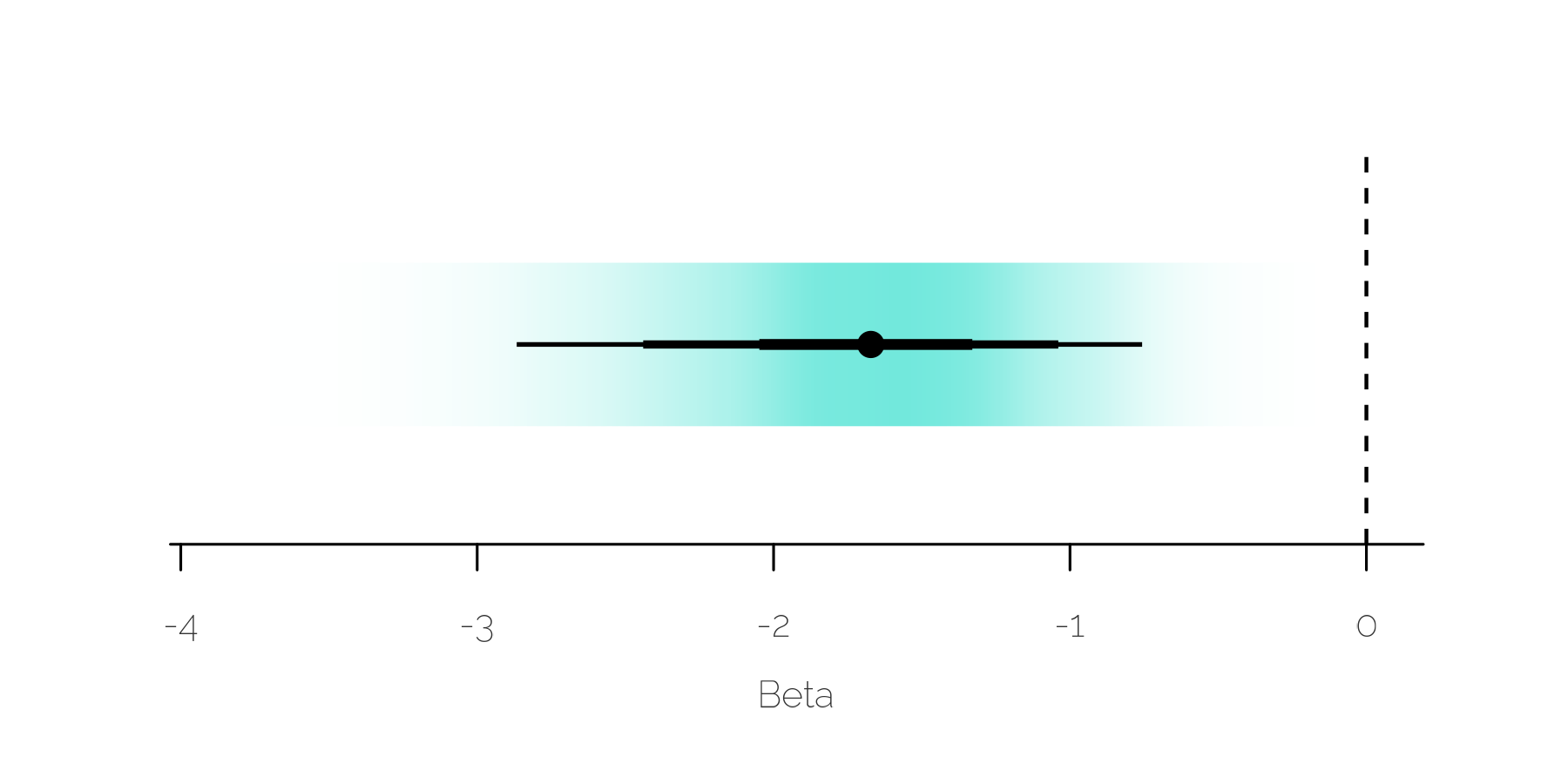
is centered around -1.7 and well below 0, outside the 95% CI. Pretty convincing, when you are the first person on the wrong side of the vote, your probability of winning decreases. In simple terms..
If there are 8 players left and one person was on the wrong side of the vote at the last tribal council, that person’s chances of winning decrease from 12.5% (1-in-8, assuming an equal chance) to 2.9%, a drop of 75%.
It is not quite as simple as this, though. For example, consider a case where there are 9 players left and 4 players were on the wrong side of the vote. They only need one person from the 5 majority to flip to give them the edge. A better chance than being the only person on the wrong side of the vote.
But as a general guide, after the merge, the player(s) on the wrong side of the vote, their chances of winning take a massive hit. A 75% hit! They have work to undo that damage. It’s a very clear trend in the data.
Quick stats
Here are some other quick stats.
Out of 48 seasons, a player who was first to be on the wrong side of the vote has won only 3 times. Assuming equal chance, we would expect 13-14 players. From above, this is a very significant difference.
If you were wondering who those 3 are, here you go.
| season | castaway |
|---|---|
| S17 | Bob |
| S11 | Danni |
| S9 | Chris |
No one since Gabon, season 17, has won and been one of the first players on the wrong side of the vote.
Final thoughts
Yes, it is very important to be on the right side of the vote! It all makes sense. If you take a shot and miss, you’re now in the minority and have a lot of work to do to get out of the hole. Even if you make it to the final tribal council, it’s very hard to convince the jury you played a very strategic game and were in control.
This sounds bleedingly obvious, but I’ve been able to confirm it and measure the effect of being on the wrong side of the vote.
I think this is pretty cool, tbh. The effect is massive, and it really shows the importance of this critical part of the game.
If you find something odd or needs correcting in this analysis, please let me know on BlueSky or Email (hit the button below).
Code
This won’t run out of the box, but will give you an idea of model setup. Reach out for help if you’d like to recreate this analysis.
# first-wrong-side-of-vote.R

library(rstan)

df <- survivoR::vote_history |>
  filter_us() |>
  mutate(vote_event = replace_na(vote_event, "OK")) |>
  group_by(version_season, order, vote_order) |>
  filter(
    vote_order == 1,
    !is.na(vote),
    vote_event != "Extra vote",
    sum(nullified) < n()/2
  ) |>
  distinct(version_season, episode, order, castaway_id, castaway, vote, voted_out, split_vote, voted_out_id) |>
  add_successful_boot() |>
  group_by(version_season, castaway_id) |>
  add_merge_episode() |>
  filter(episode >= merge_episode) |>
  semi_join(
    survivoR::boot_mapping |>
      filter_post_merge(),
    join_by(version_season, castaway_id)
  ) |>
  group_by(version_season, order) |>
  mutate(p = 1/(n()-1)) |>
  filter(
    castaway != voted_out,
    !successful_boot
  ) |>
  group_by(version_season) |>
  slice_min(order) |>
  add_winner() |>
  summarise(
    episode = episode[1],
    p = sum(p),
    n_win = sum(any(winner)),
    log_odds = log_odds(p)
  )

df |>
  ungroup() |>
  summarise(
    n = n(),
    n_win = sum(n_win),
    e = sum(p)
  )

mat <- matrix(runif(4000*nrow(df)), nrow = 4000, ncol = nrow(df))
p <- df$p
z <- apply(mat, 1, function(x) sum(x <= p))
table(z)
sum(z <= 10)/4000

# stan model --------------------------------------------------------------

stan_code <- "data {
  int<lower=0> N;
  array[N] int<lower=0, upper=1> y;
  array[N] real<lower=0, upper=1> p;
  array[N] real log_odds;
  real mu0;
}

parameters {
  real beta;
}

transformed parameters {
  array[N] real<lower=0, upper=1> kappa;
  for(k in 1:N) {
    kappa[k] = 1/(1+exp(-(log_odds[k] + beta)));
  }
}

model {
  beta ~ normal(mu0, 1.5);
  y ~ bernoulli(kappa);
}"

stan_dat <- as.list(df)
stan_dat$N <- nrow(df)
stan_dat$y <- stan_dat$n_win
stan_dat$mu0 <- 0

mod_stan <- stan(
  model_code = stan_code,
  data = stan_dat
)

beta <- rstan::extract(mod_stan, "beta")$beta
hist(beta, breaks = 60)
p0 <- 0.125
z <- log_odds_inv(log_odds(p0) + beta)
mean(z)
mean(z)/p0
hist(z, breaks = 60)


